1. 1 min

    Columns from Tabletalk Magazine, December 2008

    The December edition of Tabletalk is out. This month's theme is "Paradise Lost and Regained." The issue explores basic elements of Christianity, including the loss of paradise by our first parents and how it was regained by Jesus Christ.
    Contributors include R.C. Sproul, Iain Campbell, Chris Donato, Robert Field, Simon Kistemaker, David VanDrunen and Guy Prentiss Waters.
    We do not post all of the feature articles or the daily devotionals from the issue, so you'll have to subscribe to get those. But for now, here are links to a few select columns and articles from this month: Coram Deo (Living Before the Face of God): "Paradise Now and Then" by Burk Parsons
    Right Now Counts Forever: "The Mystery of Iniquity" by R.C. Sproul
    Pastor's Perspective: "Dreams of Paradise" by Robert W. Field
    Pro Ecclesia (For the Church): "The Prevailing Church (pt. 1)" by Simon Kistemaker
    Generation to Generation "Expectant Christians" by Iain D. Campbell
    Tolle Lege (Take Up and Read): "Pop Goes the Evangelical" by Keith A. Mathison
    Seek Ye First: "Some Dance to Forget" by R.C. Sproul Jr.
    Truth and Consequences: "An Epic in the Making" by Gene Edward Veith
    Christmas is approaching and Tabletalk is always a popular gift. Learn how you can get a free copy of Dr. Sproul's The Holiness of God for you and the gift subscription recipient. Get started by calling one of Ligonier Ministries' resource consultants at 800-435-4343 (8am-8pm ET, Mon-Fri; 10am-5pm ET Sat) or click here to purchase a gift subscription online. Please allow 6-8 weeks before delivery begins.

    Ligonier Updates
  2. Magazine

    July 2016 Tabletalk

    The July 2016 issue of Tabletalk looks at doubt and assurance. The quest for full assurance of salvation has long concerned the people of God. Many have felt the tension expressed by the psalmist, “If you, O Lord, should mark iniquities, O Lord, who could stand? But with you there is forgiveness, that you may be feared” (Ps. 130:3–4). This question was especially important during the Reformation, when some of the finest theologians and pastors in church history gave careful attention to developing a biblical doctrine of assurance. This issue uses chapter 18 of the Westminster Confession of Faith as a summary of the Bible’s teaching in order to encourage readers in the beautiful and comforting truth of the doctrine of assurance.Contributors include R.C. Sproul along with John W. Tweeddale, Iain D. Campbell, Derek W.H. Thomas, Jason Helopoulos, Joel R. Beeke, and Geoffrey Thomas.

    $3.00
  3. 3 min

    How the Gospel Brings Us All the Way Home, New from Reformation Trust

    If you were to think of the best news imaginable, what would come to your mind? That you are debt free? Healed from a terminal disease? Perhaps a new job after a long period of unemployment? While each of these examples would certainly be good news, in his new book Dr. Derek W.H. Thomas asks us to consider this as the best news imaginable: “There is therefore now no condemnation for those who are in Christ Jesus” (Rom. 8:1).
    Thomas writes, “Our status in relation to Christ makes all the difference. Outside of union with Christ, we are guilty and condemned. But ‘in Christ,’ we are declared not guilty (justified). Outside of Christ, there is only death (Rom. 5:12, 14, 17, 21); in union with Christ, there is ‘justification and life’ (Rom. 5:18, 21).”
    How the Gospel Brings Us All the Way Home leads readers through Romans 8, revealing the steps through which God leads His people in the process of their salvation, but also loving counsel on such topics as prayer, resisting the Devil, as well as exhortations and comforts for weary pilgrims. Romans 8 is an overview of the Christian life.
    Endorsements
    “In a glorious section of God’s Word, Paul sets before us the trials and the triumphs, the pains and the gains, the indicatives and the imperatives of living life as a child of God—saved by Christ, led by the Spirit, and cared for by a heavenly Father.”
    —Dr. Iain D. Campbell, Pastor, Free Church of Scotland in Point, Isle of Lewis, Scotland
    “The best books are those that instruct the mind, engage the imagination, and ignite the heart with love for God. Dr. Derek Thomas’ How the Gospel Brings Us All the Way Home does all three. With theological care, textual precision, and a pastor’s heart, Dr. Thomas holds Paul’s glorious meditation in Romans 8 to our eyes and helps us remember again just how great is the salvation Jesus won for His people. If you want a better understanding of the Bible, a deeper appreciation for the gospel, and a spur to worship Jesus Christ our Savior, this book is a great place to start.”
    —Greg Gilbert, Senior pastor of Third Avenue Baptist Church in Louisville, Kentucky
    Inside the book
    “Guilty! I can still hear that word as I close my eyes. It was 1975 in Oxford, England. I was passing by the city courthouse,where a murder trial was reaching its conclusion. The details were gruesome and the daily papers had carried detailed accounts of each day’s court proceedings. I am not sure what made me attend the final day, but I did. I watched with fascination as the judge placed a black shawl on his head just before he pronounced the final verdict: ‘Guilty.’ A roar of approval erupted in the courthouse. The defendant was found guilty of murder and condemned to a life sentence with no possibility of parole. Just as that man was found guilty in the judge’s eyes, we are all guilty in God’s sight: ‘None is righteous, no, not

    Deborah Finnamore
  4. 5 min

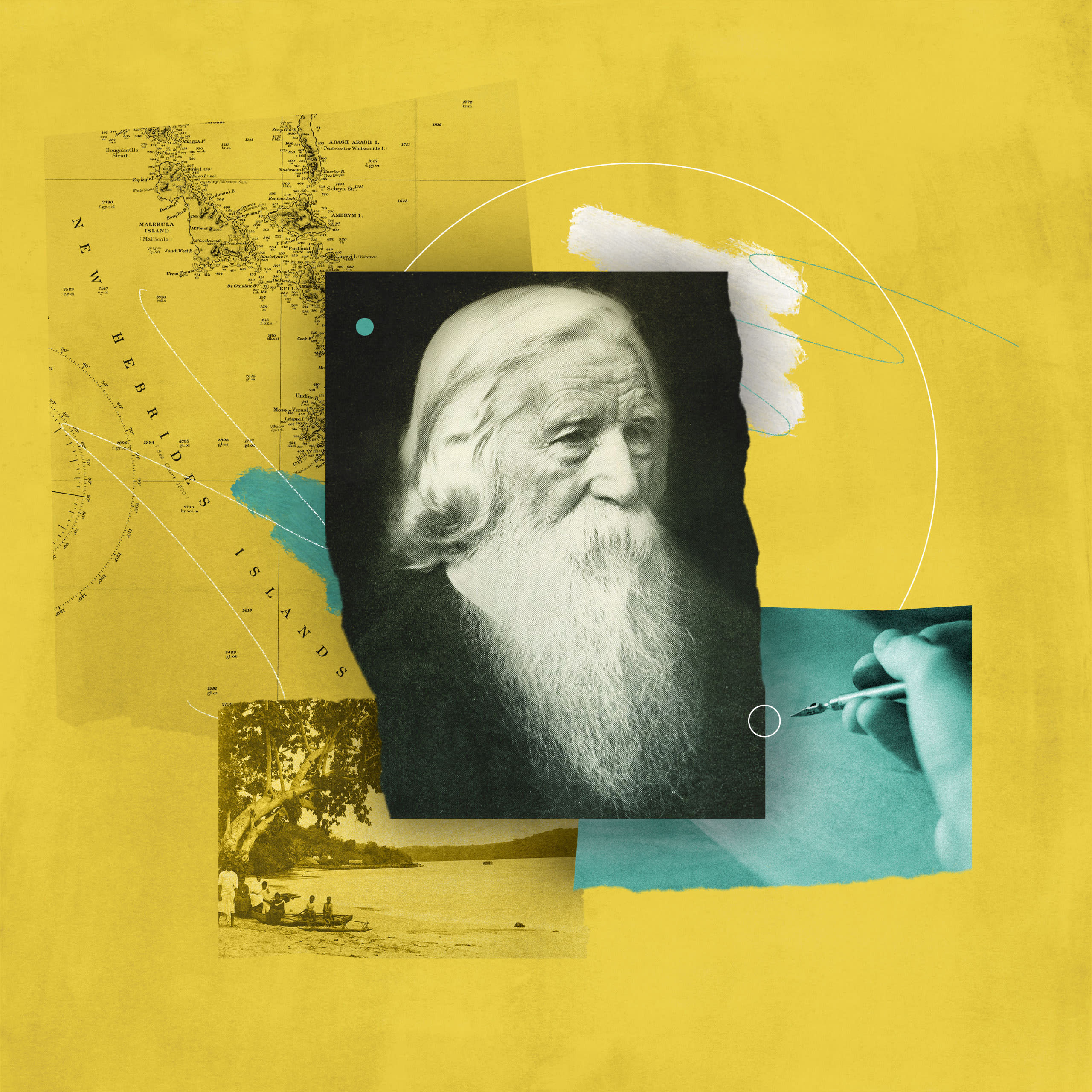
    Who Was John G. Paton?

    with more and more Missionaries. And is it to trade and to get money, like the other white men? No! No! But to tell us of their Jehovah God and of His Son Jesus. If their God makes them do all that, we may well worship Him too.
    In God’s providence, God used Paton and his efforts. Much of the island was converted. The Patons had ten children, six of whom survived to adulthood. Efforts to recruit missionaries continued throughout Paton’s life, and he campaigned in Australia, Scotland, Ireland, England, the United States, and Canada. He continued to translate and print the Bible along with his son, Fred, into his eighties, publishing the New Testament, catechism, and a hymnbook in Aniwan. Four generations of Patons went on to serve the New Hebrides church, which remains to this day. The impact of John G. Paton’s final ministry was fully sustained by the Native Teachers, the Elders, and the occasional visit, once or twice a year, of an ordained Missionary from one of the other islands. Aniwa, like Aneitym, is a Christian land. Jesus has taken possession, never again to quit those shores.
    : George Patterson, Missionary Life Among the Cannibals: Being the Life of the Rev. John Geddie, D.D., First Missionary to the New Hebrides: with a with a History of the Nova Scotia Presbyterian Mission on that Group (Toronto: James Campbell and Son, James Bain & Son, and Hart & Co., 1882), 134. : Briony Leyland, “Island holds reconciliation over cannibalism.” BBC News: Erromango, December 7, 2009. http://news.bbc.co.uk/2/hi/uk_news/england/hampshire/8398126.stm : John Paton, John G. Paton: Missionary to the New Hebrides: An Autobiography, ed. Rev. James Paton (Geanies House: Christian Focus Publications, Ltd., 2009), 17. : Ibid., 21. : Ibid., 42. : Ibid, 56. : Ibid., 125. : Ibid., 44. : Ibid., 60. : Ibid., 101. : Ibid., 86. See also 87, 129, 232. : Ibid., 55, 252. : Ibid., 91. : Ibid., 328. : Ibid., 83. See also 324. : Ibid., 82. See also 328. : Ibid., 280. : Ibid., 232. : Ibid, 244. : J. Graham Miller, Live: A History of Church Planting in Vanuatu, vol. 3 (Port Vila, Vanuatu: Presbyterian Church of Vanuatu, 1985), 273. : Paton, 354.

    Meredith Lee Myers
  5. Hardcover

    A Scottish Christian Heritage

    For 300 years a school of evangelical Christianity changed Scotland as a nation. Passing on the evangel of the Reformation, and growing stronger in persecution, it turned a people to the Bible, and finally gave many of its best sons and daughters to the ends of the earth. For fidelity, joyful perseverance in hardship, and improbable advance, the record remains a witness to the faith that overcomes the world.The compelling interest of this account lies in the way it draws on contemporary records - many of these Christian leaders being authors as well as men of action. Iain Murray's narrative explores this rich heritage and underlines its remarkable relevance for our own day. While not a Scottish Church history, this is a gripping introduction to the many glorious successes, and some of the painful failures of the church, from the days of John Knox to those of Horatius Bonar. Explaining this panoramic tapestry are the words of Knox's own commentary, 'God gave his Holy Spirit to simple men in great abundance.'As various recent publications have indicated, Scotland exercised an influence on world history out of all proportion to its size. But the real reason for this has been obscured. It will be found here, however. And in the discovery of it the reader will be introduced to a wealth of little-known literature that is a vital part of the inheritance of the whole Christian church.

    Iain Murray
    $30.00$24.00
  6. 3 min

    Reforming Our Mission

    Iain H. Murray argues, “It was Spurgeon’s own persuasion of the love of Christ for the souls of men that lies at the heart of his weekly evangelistic preaching in London for thirty-seven years.”
    Spurgeon was a deeply honest man, and he also confronted those who considered themselves to be committed to Reformed theology, but were opposed to evangelism. He preached faith as a duty, and called for persons to believe in Christ. Without apology, he stared down those, who by their denial of God’s saving purpose, brought Reformed theology into disrepute.
    The charge of diminished evangelistic passion and missionary commitment emerged over the last two hundred years as evangelical theology was itself in foment. Spurgeon simply pointed to the legacy of the modern missionary movement, driven by men such as Andrew Fuller and William Carey, whose missionary vision was deeply grounded in Reformed theology.
    In our day, John Piper has helped a new generation to understand how Reformed convictions produce a profoundly compelling missionary vision. The doctrine of election points to the glory of God, and the glory of God is demonstrated in the gladness of peoples who have come to know Christ as savior.
    As Piper explains: A heart for the glory of God and a heart of mercy for the nations make a Christ-like missionary. These must be kept together. If we have no zeal for the glory of God, our mercy becomes superficial, man-centered human improvement with no eternal significance. And if our zeal for the glory of God is not a reveling in His mercy, then our so-called zeal, in spite of all its protests, is out of touch with God and hypocritical.
    Remember these witnesses the next time you hear that Reformed theology leads to a lessening of evangelistic commitment. Those who know that God saves and the purpose for which He saves, should be the most eager and faithful witnesses to see others come to faith in the Lord Jesus Christ. Uncommitted to evangelism? That is what Reformed theology is not.

    Albert Mohler
  7. Paperback

    Spurgeon on the Christian Life

    Charles Spurgeon, widely hailed as the “Prince of Preachers,” is well known for his powerful preaching, gifted mind, and compelling personality. Over the course of nearly four decades at London’s famous New Park Street Chapel and Metropolitan Tabernacle, Spurgeon preached and penned words that continue to resonate with God’s people today.Organized around the main beliefs that undergirded his ministry—the centrality of Christ, the importance of the new birth, the indwelling of the Spirit, and the necessity of the Bible—this introduction to Spurgeon’s life and thought will challenge readers to live their lives for the glory of God.

    Michael Reeves
    $20.00$16.00
  8. 3 min

    An Apology for Apologetics

    My professor of apologetics in seminary told stories of odd reactions he received when he would tell people what he did for a living. The best story involved a bank loan officer. When he told the loan officer that he was a professor of apologetics, she replied, “That’s wonderful.” Then she added, “These days, we really do need to teach people how to say they are sorry.”
    The loan officer was both right and wrong. We do need apologetics professors, but apologetics isn’t about saying we’re sorry. Rather, it’s about defending the faith. In fact, defending the faith is so urgent today that we need more than apologetics professors—we need all Christians to realize that they are apologists.
    One of Dr. R.C. Sproul’s books is titled Everyone’s a Theologian. We could say equally that “everyone’s an apologist.” Those who are in Christ and have been brought to see the truth and beauty of the gospel have both the obligation and the privilege to defend it. We are compelled “to give an answer.” We can’t simply rely on the philosophically gifted or the culturally adept to carry the weight here. Everyone is an apologist.
    The Command
    The Greek word apologia means literally “to speak to.” Over time, it came to mean “to make a defense.” When Athens accused Socrates of being harmful to society, Socrates had to offer his defense. He titled it Apologia. He stood before the “men of Athens,” offering his reasoned defense. The New Testament uses the word seventeen times. Many instances concern court cases, such as the time Paul appeared before the Jewish Council in Acts 22 and before Festus in Acts 25. Paul also speaks of his imprisonment in Rome as an apologia of the gospel (Phil. 1:7, 16).
    The classic text for the Greek word apologia is 1 Peter 3:15–16. Peter’s first epistle was written to the “exiles” living in Asia Minor, located in modern-day Turkey. These exiled Christians were ostracized for their faith and suffered persecution. They were insulted and slandered. Some of them suffered at the hands of their own family members.
    [pullquote]
    Peter commands these exiles not to live in fear or cower before opposition. Instead, he commands these exiled Christians—and us—to be always ready to make a defense. The main verb “to make a defense,” from the Greek word apologia, is in the imperative mood. The imperative mood is used for commands. There’s no procedure for deferment here. The command extends to all of us.
    Further, Peter tells how to make our defense. He notes that we should “always be prepared.” That’s a tall order. Questions about our faith tend to come at unexpected times. In order to be always ready, we must know our faith, which means knowing our theology. We must also know our audience. We see this in Paul’s example of being an apologist on Mars Hill in Athens (Acts 17:16–34).
    Peter also tells us that we need to make our defense “with gentleness and respect” (1 Peter 3:15). That’s an even taller order. The word

    Stephen Nichols
  9. 6 min

    Who Was John Knox?

    possession of the church, and so we were compelled to give obedience to all that they demanded.” These vain excuses, I say, will nothing avail you in the presence of God.
    Return to Scotland
    In 1558, England’s “Bloody” Mary died and was succeeded by Elizabeth I. Knox sought a safe passage home through England. By this time, however, he was known as the author of the infamous polemic against female monarchs: First Blast of the Trumpet Against the Monstrous Regiment of Women, which had been published anonymously at first in Geneva and had gone on sale without Calvin’s knowledge. The safe passage was refused, and so it was by boat to Leith, the harbor for Edinburgh, that Knox finally returned home to begin his most important phase of public ministry.
    Despite his lengthy absences from his native land, several things equipped Knox to lead the Reformation there: his name was associated with the heroes of the recent past, his sufferings authenticated his commitment, his broad experience had prepared him for leadership, and his sense of call made him “fear the face of no man.”
    Knox gives a vivid account of these days in his History of the Reformation in Scotland. His famous interviews with Mary, Queen of Scots, often misrepresented, indicate his total commitment to the principles of Scripture. It was probably that total commitment that led to a dwindling of support among those from whom he had hoped so much. In earlier days, his radical vision had provided an opportunity for the nobility to lead Scotland into the future, but many were to prove too little concerned for the radical transformation of the spiritual life of the church and nation. As one modern scholar put it, “The language of the covenant had been replaced by a more seductive image—the common weal [well-being].”
    This change in Knox’s influence was illustrated at the coronation of the young James VI, where Knox preached the sermon but the ex-Roman Catholic bishop of Orkney performed the anointing of the king in accordance with the ancient rites. The return of bishops to the Kirk already had appeared over the horizon.
    By the summer of 1572, Knox was a shadow of his former self. Weakened by a stroke, it was beyond his powers to preach in the Church of St. Giles, although he managed to do so occasionally at the nearby Tolbooth. By November, it was clear he was not long for this world. On the morning of November 24, he asked his wife to read 1 Corinthians 15 to him, and around five o’clock came his final request: “Read where I cast my first anchor,” presumably in faith; she read John 17. By the end of the evening, he was gone.
    Knox himself wrote with deep gratitude to God of the work that he had seen accomplished: As touching the doctrine taught by our ministers and . . . the administration of sacraments used in our Churches, we are bold to affirm that there is no realm this day upon the

    Sinclair Ferguson
  10. 4 min

    How to Support the Caregivers in Your Church

    are absent.
    True Understanding
    Even when we manage to step out of our comfort zone to assist the caregivers in our churches, our busy attitudes often prevent us from understanding their needs. Trina, who spent years caring for her husband during his struggle with dementia and cancer, has sad memories of people limiting their prayers to the healing of cancer, while both she and her husband thought God had allowed it as a merciful end to his rapid mental decline. No one prayed for her and their children with her present.
    “We needed endurance and had concerns about pain relief, end of life decisions, and other issues,” she said. “People need to listen to or read the prayer requests and pray for those things, particularly in the hearing of the patient and caregiver. We need to feel heard by those we look to for support. And their prayers must support reality, not the wishes of the one praying.”
    Many parents of people with a serious mental condition have told me they mostly need acceptance, understanding, hope, and love—including love and true appreciation for the person needing care. “Caretakers become responsible not merely for their loved ones’ physical care, but also to help them see a continuing purpose in their lives,” Trina told me. “I needed to remind my husband that he was an image bearer who could still bless his family. It’s important to thank our loved ones for how they bless us and go before us. I am realizing more and more what my husband’s example of suffering means to me and those who witnessed it intimately.” The church can assist in this work of appreciation.
    Love, understanding, and appreciation require a commitment of time that is rare in a pragmatic society that emphasizes quick solutions. If we visit a person in need, we often feel compelled to resolve their problems or at least provide useful suggestions. Yet, this might be the worst thing we can do for people who have been trying to navigate, through a careful exercise of wisdom and attention to professional advice, the complexity of their situation.
    The best thing to do is to be present as faithful friends, ready to stick around, listen, and learn. Getting involved in the lives of caregivers and their loved ones may seem like a sacrifice, but it’s well worth it for everyone involved. If we are convinced that “the body does not consist of one member but of many” (1 Cor. 12:14), and each is necessary for the building up of the church, we will treat each other as such and—in the process—grow in maturity, love, and wisdom.
    This article is part of the Common Christian Struggles collection and was orginally published July 19, 2024.

    Simonetta Carr
  11. 3 min

    3 Things You Should Know About Lamentations

    the midst of sin and suffering.
    Lamentations forces us to grapple with complex theological questions, including the problem of evil and the relationship between God’s holiness, justice, and mercy. While it does not provide easy answers, it invites us into a deeper theological exploration, compelling us to understand these harsh realities in the light of God’s perfect wisdom, goodness, and truth.
    1. Lamentations provides a framework for godly mourning and repentance.
    In a contemporary culture that often stigmatizes expressions of sorrow, Lamentations stands as a poignant counternarrative. It not only validates lament as a permissible emotional expression but demonstrates that it is a means to seek God’s face in life’s darkest moments. Beyond this, the book serves a dual purpose: it acts as both an emotional outlet and a theological guide for spiritual renewal.
    Lamentations offers a roadmap for spiritual renewal, beginning with acknowledging and grieving over sin. It then leads the reader through the process of expressing this grief as heartfelt lament, a crucial step toward repentance. Ultimately, the text points to the anticipation of God’s redemption and restoration, defining a path that culminates in placing trust in the Lord. Lamentations also presents the means for spiritual renewal, inviting us to seek the Lord in faith and obedience.
    Conclusion
    Lamentations goes beyond Israel’s historical context to foreshadow the redemptive work of Christ. Just as Israel faced the consequences of breaking the covenant, humanity faces the ramifications of Adam’s first transgression. Christ, the truly obedient Son, takes upon Himself the sins of the world, offering to His people not merely temporal but eternal restoration.
    Lamentations combines theological and emotional elements, covering themes of human suffering, divine justice, and the complexities of faith in a broken world. It challenges us intellectually and engages us emotionally, offering a deep well of wisdom for those willing to explore its teachings. By grappling with these complex themes, we not only gain a more comprehensive understanding of sin and suffering but we also see the foreshadowing of Christ’s redemptive work. In the end, Lamentations teaches us that even in the depths of despair, hope exists when we turn to Christ, our Redeemer.
    This article is part of the Every Book of the Bible: 3 Things to Know collection.

    Camden Bucey
  12. 3 min

    8 Lessons on Evangelism from Proverbs

    Would you like a course in evangelism? Have you considered reading the book of Proverbs? Here are some of the lessons about how to evangelize that I recently learned while studying the book.
    1. Personal
    The dialogues in Proverbs are not impersonal, detached, and distant, but close, intimate and warm. It’s one person to another person, first person singular to second person singular, it’s an “I” addressing a “you,” not a “we” addressing a “they.”
    The personal dimension is further enhanced by the frequent addressing of the reader as “my son,” especially in the first nine chapters. Even if the person we’re evangelizing is not our literal son, that’s the way we should view them and speak with them. It’s not about winning an argument, but about building a relationship.
    2. Persuasive
    Solomon is not a lecturer, he’s a pleader. Solomon is not simply reciting facts, he’s persuading souls. He marshals multiple arguments, varied illustrations, pithy sayings, and memorable narratives to convince and persuade his reader to turn from folly to wisdom. He’s calling, alluring, beseeching, appealing, and imploring. This great king is not ashamed to beg for attention and for change. He’s a passionate and compassionate orator.
    3. Vivid
    Whereas the Apostle Paul’s main evangelistic weapon was his systematic and logical reasoning, Solomon’s was vivid word pictures. He personifies Lady Wisdom and Madam Folly. He then paints each of these contrasting ladies in graphic and striking colors: folly in all its lurid ugliness; wisdom in all its compelling beauty. He scours the world for unforgettable images and metaphors to bring home the truth to the conscience.
    4. Convicting
    Every Proverb is traceable to one of God’s moral laws, summarized in the Ten Commandments. We, therefore, should not be surprised if the Proverbs often leave us feeling guilty and condemned. We read one after another of these incisive little epigrams and sometimes feel as if our souls are getting strafed with a machine gun. The cumulative impact is humbling and heart-breaking.
    [pullquote]
    As we read the early parables in the book, often portraying a young man choosing foolish paths, we shake our heads until we realize that we are reading out own biography.
    5. Attractive
    Solomon doesn’t just show us how ugly sin is to scare us off. He also shows us how winsome wisdom is. Wisdom captivates, fascinates, intrigues, attracts, allures, and enthralls until we are drawn, not just willingly but irresistibly, to her magnetic charms. Yes, we need to dissuade from sin, but the biggest dissuader is the beauty of divine wisdom.
    6. Clear
    Solomon never used light gray when he could use luminous highlighters. There's no middle ground in Proverbs, no confusing fog, no fudgy compromises. There are two ways, two choices, two destinations, and only two. There is the way of wisdom and the end everlasting life. There is the way of folly and the end everlasting death. The choice could not be made any clearer, not in the lengthy dialogues of Proverbs 1-9 and especially not in the multiple Proverbs that present the choice

    David Murray
  13. 72 min

    The Attractions of the New Perspective(s) on Paul

    derogatorily call "a Lutheran standpoint."
    Israel's Law and the Church's Faith: Paul and His Recent Interpreters (Wipf & Stock), 1998, by Stephen Westerholm. Westerholm is a mainstream scholar who acknowledges some of the Sanders-inspired "correctives" of the traditional Protestant account of Judaism, yet who also ably defends the classic Protestant position. N.T. Wright himself says that Westerholm gives "careful, measured, and reasonable argument for a non-Sanders position on Paul and the law."
    C. Just Can't Get Enough? (More Articles Advancing/Critiquing the New Perspective)
    You'll find plenty of follow-up bibliography in the above-listed books, but you may still want to look at some of these articles (all are available and linked through the above-listed websites, see pages 1-2, under I.). Brief articles can sometimes help clear one's cloudy-headiness when having just digested 900 pages of new perspective material and you can't remember which way is north.
    Articles Advancing or Describing the New Perspective
    Abraham in Romans 4: The Father of All Who Believe by Michael Cranford. This article from New Testament Studies approaches Romans 4 from the new perspective.
    Coming Home to St. Paul? Reading Romans a Hundred Years after Charles Gore. A fairly recent lecture by N.T. Wright. Typical Wright: witty, engaging, compelling (hold onto your heart when you read him).
    E.P. Sanders and the New Perspective on Paul is an outline from a lecture on background to the current debate on the new perspective that was given at Tyndale House in Cambridge, U.K. It comes up on a "Google" search of the internet and is linked from "the Paul Page" as well.
    The New Approach to St. Paul and to the Letter to the Romans. A summary from the web page of the Lowestoft and East Suffolk Circuit of the Methodist Church in Great Britain. Good brief summary in bullet-point style.
    The Western Captivity of the Apostle Paul by Jack Poirier. An short description of the main beefs of the new perspective with the "traditional" approach. Gives the typical new perspective schtick on why we have to abandon the "Westernized" version of Paul.
    Articles Challenging the New Perspective
    New Views regarding Legalism and Exclusivism in Judaism: Is there a need to reinterpret Paul? by Gerhard H. Visscher. This article from Koinonia is superb and helpfully criticizes the work of Sanders and Dunn, as well as deducing the huge pastoral problems caused by the new perspective.
    The Doctrine of Justification by Faith by Robert Forsyth. A very brief address by a conservative, reformed, Anglican bishop (who is a friend of N.T. Wright's) criticizing Wright's view of justification and spelling out the classical view.
    The Eschatological Aspect of Justification by James T. Dennison, Jr (formerly of WTS-California), is a short lecture on Romans 4:25, published in Kerux, criticizing Sanders, Dunn, and various other miscreants.
    Tom Wright and the New Perspective. Australian bishop and New Testament scholar Paul Barnett provides a crushing and informed criticism of Wright's views on justification (originally called "Why Wright is Wrong"). N.T. Wright responds with a waffling column, available in the Biblical Archaeology Society e-zine, called The Shape of Justification.
    Footnotes
    This is

    Ligon Duncan
  14. 3 min

    Top 5 Commentaries on the Book of Joel

    While most of the other prophets can be dated with some degree of accuracy, it is notoriously difficult to date the book of Joel. Suggestions have been offered ranging from the ninth century to the second century B.C. Among conservative scholars, three main views are suggested. Some suggest an early pre-exilic date in the late ninth or early eighth century. Others suggest a late pre-exilic date in the seventh century. Still others argue that a post-exilic date in the late sixth to the mid-fifth century best explains the content of the book. While evidence for each of these views has been presented, no one has yet established a decisively compelling argument for any of them. In my opinion, the case for a late pre-exilic date is the most persuasive. There are a number of good commentaries on Joel, and the following are five of the most helpful.
    1. Douglas Stuart — Hosea-Jonah (Word Biblical Commentary, 1987). I have already mentioned in my comments on Hosea commentaries that the best commentary on the first five minor prophets is the commentary by Douglas Stuart in the Word Biblical Commentary series. Stuart argues that Joel is a late pre-exilic prophet, a view with which I agree. He also takes a minority view on the interpretation of Joel chapter 1, seeing the locust invasion as a figurative description of a human army rather than a literal locust plague. I find his arguments persuasive on this point. Whether you agree or disagree on that point, however, his commentary is always worth consulting on these books. Very highly recommended.
    2. Thomas E. McComiskey — The Minor Prophets (2009 [1992]). Also mentioned in connection with my post on Hosea is the commentary edited by Thomas McComiskey. The commentary on Joel in this volume was written by the late Raymond Dillard. I do not agree with Dillard’s conclusions regarding the date of the book (he suggests a post-exilic date in the late fifth to mid-sixth century) or the interpretation of the locust plague in chapter 1 (he argues that it is a description of a literal locust plague), but, nevertheless, his commentary is very useful, especially on the details of the Hebrew text.
    3. David Allan Hubbard — Joel & Amos (Tyndale Old Testament Commentaries, 1989). I placed Hubbard’s commentary on Hosea in fourth place in my post on Hosea commentaries. His commentary on Joel takes the bronze. He is in general agreement with Dillard on the date of the book and the interpretation of the locust plague in chapter 1. His commentary, however, is written at a much more accessible level.
    4. O. Palmer Robertson — Prophet of the Coming Day of the Lord: The Message of Joel (Welwyn Commentary Series, 1995). Also written at an accessible introductory level is the commentary by O. Palmer Robertson. Robertson places the book in the late ninth or early eighth century, in the very early pre-exilic period. He appears also to take the majority view of chapter 1, seeing the description of the locust

    Keith Mathison
  15. 3 min

    Is the Bible the Word of God?

    When it comes to the truth of the Bible, modern people often think like George Gershwin: “The things that you’re liable to read in the Bible, it ain’t necessarily so.” After all, says the skeptic, this book is so chock full of fanciful stories and over-the-top miracles that no reasonable person could believe it. Why should we think the bible is actually from God?
    Of course, it needs to be acknowledged that convincing the skeptic of the divine origins of Scripture is no easy task. Since “the natural person does not accept the things of the Spirit of God” (1 Cor. 2:14), it is not as simple as just presenting the facts. The Bible is a spiritual book, so the Spirit must work for us to see it for what it is.
    Our arguments may not always convince the skeptics, but that does not mean our arguments are invalid. God has provided ways that we can know these books are from Him.
    Divine Qualities
    First, we must recognize that the biblical books have internal qualities that demonstrate that they are from God. Just as natural revelation (the created world) has characteristics that show God is the author of nature (Ps. 19; Rom. 1:20), so we should expect special revelation (Scripture) to have such characteristics that show God is its author.
    One example is the efficacy and power of Scripture. It’s not just that Scripture says things, but the Scripture does things. It convicts (Heb. 4:12–13), it encourages (Ps. 119:105), it comforts (v. 50), and it brings wisdom (v. 98). In short, this book is alive. Even more than this, the Bible brings understanding in regard to the biggest questions of life (v. 144). It provides a coherent and compelling worldview that explains reality like no other book.
    Another example is the unity and harmony of Scripture. It is incredible to behold how so many different authors—writing in different times, locations, and cultures—can weave together a single, unified, coherent story of the redemption of all things through Christ. Such harmony is not man-made but evidence of a divine origin.
    [pullquote]
    In short, Christians know the Scriptures are God’s Word because in them they hear the voice of their Lord. As Jesus declared, “My sheep hear my voice, and I know them, and they follow me” (John 10:27).
    Historical Origins
    In addition to the internal quality of these books, we can also look to the historical origins of these books as evidence of their unique character. These books come from God’s authenticated messengers, prophets and Apostles who were authorized to speak for Him. The Scriptures contain not just the words of human beings but the words of human beings who were called to be God’s mouthpieces (2 Peter 1:21).
    Of course, we are not always certain of the particular author of every biblical book (for example, the book of Hebrews). But, even in such cases, we have solid historical evidence that situates these books in time periods and circumstances where we know God was actively working among His people

    Michael Kruger
  16. 3 min

    Truth-Telling and the News Media

    NBC announced Tuesday that it suspended its lead news anchor Brian Williams for six months without pay. Network brass concluded that Williams embellished his experiences covering stories over the years; most notably that he was in a U.S. Army helicopter that was hit by enemy fire during the Iraq War in 2003.
    I've taken more than a passing interest in the story since I share a couple of things in common with Mr. Williams. First, before coming to Ligonier Ministries, I spent nineteen years in a position similar to his, as the lead news anchor for the Christian Broadcasting Network. Second, during an earlier stint as a news anchor for a local station in Jacksonville, Florida, I was suspended without pay. Station management didn't take kindly to me telling a group of politically active Christians that I believed the news media had a bias against them. So, I can relate to Brian when he admits, "I am presently too much a part of the news." Some observations regarding the current controversy:
    Telling the whole truth
    As much as I applaud NBC News for its desire to get to the bottom of this controversy and protect its reputation, I would argue the news media's problem goes far beyond a news anchor's embellishment of his wartime experiences. If we're going to hold one man accountable, let's also hold every news organization in this country accountable for their failure to tell us the truth about a number of stories, particularly abortion.
    It's my opinion that the bias of many network news organizations exists, not just in the stories they cover, but ones they refuse to cover. It is shameful that none of the networks have told us the truth about the physical and emotional pain caused by the slaughter of millions of unborn babies in this country.
    Information vs. Wisdom
    Let me encourage you to try an experiment. Watch any newscast on any network tonight and take an inventory of the stories covered. Then ask yourself this question: "How many of these stories have a real bearing on my life?" I suspect your answer will be, "Very few."
    It should be a reminder that there's an important difference between information and wisdom. The Proverbs tell us, "Blessed is the one who finds wisdom, and the one who gets understanding, for the gain from her is better than gain from silver and her profit better than gold" (Proverbs 3:13-14).
    Former history professor, Dr. C. John Sommerville, has written a compelling book on the subject of news called, How the News Makes Us Dumb: The Death of Wisdom in an Information Society.
    Sommerville concludes we would be far better served turning off the news, putting down our newspapers, and reading a good piece of literature. I agree, but add we should begin with God's Word, the source of all wisdom. That's why I am grateful for the new calling God has given me to assist Dr. R.C. Sproul and others in proclaiming truth each day on Renewing Your Mind.
    **One more thing in common with

    Lee Webb
  17. 6 min

    Desiring God: An Interview with John Piper

    may not be the one you dreamed. When I was twenty-eight years old, I had finished formal education and had a wife and a child. One door of ministry opened to me. I took it as God's gift and confirmation. I had never dreamed of teaching at Bethel College. It was a gift. And it was the next step in my call to the Word.
    TT: What are the unique challenges faced by those converted to Christ as children as opposed to those converted later in life?
    JP: If you grow up in the Alps, you will have a harder time feeling wonder than a grown person who sees them for the first time. So the challenge is to see with stunning clarity, and savor with passion, what you have heard all your life. This means that for most of us there are stages of "awakening." It may be that we were never converted and that one of those awakenings is our new birth. But just as often, I think, a truly believing young person opens his eyes one day, and he is stunned at the glory of what he has known and loved all his life. Then it happens repeatedly for the rest of his life as God gives greater capacities for seeing and savoring.
    TT: If you could spend twenty-four hours alone with any theologian from church history, who would it be and why?
    JP: It would be Jonathan Edwards, mainly to say thank you with all my heart. Edwards is the most influential dead theologian in my life outside the Bible. He has eyes like no one I have ever read. He sees greatness where it is. I look at greatness often and don't see it. Then I read Edwards and I realize how blind I am.
    Most of the greatness that he sees is in God. He is a God-besotted person. The reality of God is so overwhelmingly pervasive in the world that Edwards does not have other themes, but only subthemes connected to God. When I read him, it's like living in a garden where all the lights just went on. The blazing sun of God's greatness and glory fills the air with brightness, and every color and fold and angle and tilt and texture and fragrance and color and void between the edges of things—all of it lives with God.
    Edwards' mind was uncommonly capable of holding complexities of reasoning long enough to sort them into threads that he could then weave into compelling arguments for great biblical truth. But what gave explosive power to this use of reasoning was how Bible saturated it was, not just that it was Bible-based. Many scholars say their work is based on biblical truth. But you will look in vain for any clear evidence of that. It is as if contemporary thinkers feel the need to hide the Bible lest they be accused of proof-texting. Edwards was not so insecure. He had more respect and confidence in the Word of God.
    Then add to

    John Piper
  18. 28 min

    The Presbyterian Doctrine of Total Depravity

    to be examined, at the outset, to give a proper frame of reference. Arising out of rationalism, the first objection assumes that depravity simply means extreme irrationality and the consequent inability to communicate, or to think, i.e., that sin means man ceases to be man. But such a thought misses the point. As a sinner, man does not cease to be man; he ceases to be good. The theist does not deny that a degree of irrationality appears as a secondary effect of depravity, but does deny that it is the main hallmark of depravity. As Baillie puts it: “A completely unreasonable being would be as incapable of wickedness as of goodness, for he would be simply non-moral.” In a theistic setting, the worst thing that can happen to a person is not that he should become incoherent in irrationality (as undesirable as this may be), but rather that, while remaining coherent and rational, he be obdurate in his relationship to God. Rationality in itself, in man, does not guarantee goodness. Rationalism as a philosophy fails to see that various starting points and differing teleological elements will give rise to a variety of rational systems, each with its own criteria of moral and epistemic value. The shrewd rationality of a man bent on evil is undoubtedly judged by God, while the fumbling thought of a God-fearing peasant is undoubtedly blessed.
    The second difficulty seems embarrassing to our study because it suggests that theological ideas must be derived from empirical observations of human behavior, and in the light of such observations we should be constrained to conclude that man is basically good rather than evil, or at least his good deeds outnumber his evil. But such a criticism does not possess compelling weight. Aside from empiricism’s problem in knowing what the motives of observed “good” human activity might be, a further difficulty in measuring the consequences of various moral alternatives, another liability in this objection is evident. Speaking of human action as good (or evil) assumes we already know and have used a non-empirical criterion in naming an act as good or evil. Furthermore, saying that a man is good because his good actions outweigh his evil ignores the possibility of one evil act outweighing all the good. The assumptions empiricism must make in order to project any kind of a universal claim show its incoherence and render its discussion of depravity highly suspect.
    Reformed theologians also clearly reject the allegations of rationalism and empiricism as set forth in the preceding paragraphs. Without denying that the totally depraved man engages in reasoning, R.C. Sproul points out that his effort is “futile” reasoning, because it proceeds from a primary premise that is faulty and produces only the final fruit already present in the initial bias. . . . It ends in darkness because it abhors the light at the beginning. . . . Brilliant and erudite reasoning may produce abhorrent conclusions if they proceed from a faulty starting point.
    A further indication of

    Thomas Gregory
  19. 3 min

    The Covenant Way

    the first proclamation of the gospel (Gen. 3:15). The promise would be kept through the offspring of the woman. Adam’s response to this good news was to name his wife, an indicator that he was restored to headship. He named her Eve “because she was the mother of all living” (v. 20). This leaves me breathless. Eve means life-giver. The life-taker was restored to her pre-fall ability to be a life-giving helper because of the gospel.
    Woman’s redemptive calling to be a life-giver is not just biological. The redeemed woman is called to be a life-giver in every season, relationship, and situation. And get this — only redeemed women have the ability to display God’s creation design and redemptive calling. This, too, leaves me breathless.
    Multiplying and taking dominion is still the church’s compelling commission. Headship and submission are still the church’s compelling relational framework for men and women to live out our covenantal privileges and responsibilities. When Paul told Timothy, “I do not permit a woman to teach or to exercise authority over a man” (1 Tim. 2:12), he referred to judicial or governing authority. And he quickly gave the reason: “For Adam was formed first, then Eve” (v. 13). The governance of the church is to reflect the creation order, thus reflecting the character of God, thus reflecting the gospel.
    Headship and submission are God’s ordained order to achieve oneness in marriage and unity in the church. Whenever a woman inverts this order, she becomes a life-taker. Instead of nurturing a sense of place and family in her home and church, she sucks the life out of that relationship/situation. Biblical submission liberates us to make the kingdom reality of God’s female design and calling visible to our families, friends, and neighbors, and to the next generation.
    Why would we rebel against such a high and holy calling? The same reason Mother Eve did — pride. We are vain women and we live in Vanity Fair. We need the gospel, and we need the church and other women to help us know how to orient our lives to the gospel — it’s the covenant way

    Susan Hunt
  20. 4 min

    Dealing with Differences

    deeply interested in them — and are eager to learn from them as well as to help them.
    Second, we need to ask the question: “What can I learn from those who differ from me?” It is not censurable selfishness to seek to gain maximum benefits from any situation that we encounter. It is truly a pity if we fail to take advantage of opportunities to learn and develop what almost any controversy affords us.
    The first thing that I should be prepared to learn is that I am wrong and the other person is right. Obviously, this does not apply to certain basic truths of the faith like the deity of Christ or salvation by grace. Yet, apart from issues where God has spoken so that doubt and hesitancy are not permissible, there are numerous areas where we are temperamentally inclined to be very assertive and yet can quite possibly be in error. When we are unwilling to acknowledge our fallibility, we reveal that we are more interested in winning a discussion and safeguarding our reputation than in the discovery and triumph of truth.
    Moreover, we may learn from one who differs from us that our presentations, while correct as far as they go, fail to embody the truth in its entirety on the subject in view. Although what we assert is true, there are elements of truth that, in our own clumsy way, we have overlooked. The person who differs from me may render me great service by compelling me to present the truth in its completeness and thus avoid pitfalls created by under-emphasis, over-emphasis, and omissions. Thus my account will be “full-orbed” rather than “half-baked!”
    Finally, it is also proper to raise the query: “How can I cope with those who differ from me?” That is to say, how are we to argue with others?
    In evangelical circles, biblical arguments carry a maximum of weight if properly handled, for they invoke the authority of God Himself in support of a position. Yet we must ever strive to take account of the fullness of biblical revelation to have the boldness to advance as far as it leads, and the restraint to stop in our speculations where the Bible ceases to provide guidance.
    Beyond this, we must also employ general arguments, namely logic, history, and tradition. While the authority involved is not on the same level as the Bible, it has a bearing on the discussions and must be considered by those who wish to make a strong case.
    Perhaps the most important consideration for the Christian is to remain aware at all times of the goal to be achieved. Are we attempting to win an argument in order to manifest our own superior knowledge and debating ability? Or are we seeking to win another person whom we perceive as enmeshed in error or inadequacy by exposing him to the truth and light that God has given to us?

    Roger Nicole
  21. 5 min

    Historical Propaganda

    general consensus was already evident at that gathering. The New Testament writings were recognized and set apart because of their authorship by one of the apostles and by their clearly orthodox content — in harmony with the other New Testament writings as recognized by the churches spread throughout the Greco-Roman world.
    The Da Vinci Code weaves fact and fiction with such recklessness that the average reader will assume all its claims to be factual. There was in fact an ecumenical council at Nicea, but Brown’s account of it is preposterous. The real Council of Nicea adopted a creed in order to reject the heretical teachings of one Arius, who taught that Jesus was not of the same substance as the Father. The council did not “invent” the divinity of Jesus. This was already the declaration of the church, claimed by Jesus Himself as well as by the apostles. The council boldly claimed this as the faith of the church, naming Arianism as a heresy and Arians as heretics. A close vote? Only two out of more than three hundred bishops failed to sign the creed. Not exactly a cliff-hanger.
    Much more could be considered, but the main issue is this: How plausible is such a conspiracy? The threshold of credibility for this conspiracy requires us to believe that the entire structure of Christian theology is a sinister plot to fool the masses. Further, we must believe that the leaders of this conspiracy knew that Jesus was not the Son of God, but were willing to die for this cause by the millions. As C. S. Lewis once argued, people might be willing to be martyred for a lie if they are innocently deceived, but very few will die for what they know to be a lie. What is more, it requires one to believe that the truth, known by millions, has been kept secret from the world until now. Specifically, until the release of The Da Vinci Code. Those who want to believe the heresies of The Da Vinci Code will hold to them tenaciously — whatever the evidence. Clearly, the book attacks the Scriptures, the Christian faith, and the Gospel itself, but the truth is unshaken. G. K. Chesterton reminded us that orthodoxy is not only true; it is infinitely more interesting than heresy. It is alive and compelling and life-changing. Heresies come and go by fashion. The truth is unchanged and unchangeable. Caveat emptor, “let the buyer beware.”

    Albert Mohler
  22. Beyond the Ceiling

    I can’t tell you how many times I’ve heard people say, “I pray, but I don’t feel like my prayers get beyond the ceiling.” Most of us have felt this way at one time or another. We may know the biblical truth that God listens from heaven, but we aren’t sure that our prayers actually reach Him. When we lack this confidence, Scripture offers a solution. If we want to know that our prayers go beyond the ceiling, we need to set our hearts on the things above and become captivated by the glorious, heavenly throne room of God.
    Both in the Old and New Testaments, God’s faithful people often approached Him in worship and prayer with the eyes of their hearts turned upward toward heaven and what happens there. Listen to just one example in Psalm 29:1–2:
    Ascribe to the Lord, O heavenly beings, ascribe to the Lord glory and strength. Ascribe to the Lord the glory due his name; worship the Lord in the splendor of holiness.
    As we can see here, the psalmist focused his heart and mind on two dimensions of the heavenly throne room of God.
    The Worship of God
    In the first place, notice that the psalmist was so inspired by his awareness of the throne room of heaven that he addressed the “heavenly beings.” In fact, he cried out for them to join him in his worship: “ascribe to the Lord . . . ascribe to the Lord . . . worship the Lord.” In effect, he called for the creatures of heaven to join him in worship, much as we do when we sing the traditional Doxology: “Praise Him all creatures here below; praise Him above ye heavenly host.”
    The Splendor of God
    In the second place, and even more inspiring, the psalmist fixed his heart on “the Lord in the splendor of holiness.” As Psalm 104:1–2 puts it, God reveals Himself in heaven as One “clothed with splendor and majesty . . . with light as with a garment.” Or as Revelation 4:3 says, God discloses Himself in heaven with “the appearance of jasper and ruby.” Isaiah 6:2 tells us that the holy radiance of God on His throne is so overwhelming that even the seraphim ministering before him cover their eyes. As the psalmist turned toward heaven, he was amazed at the Lord’s “glory and strength” and “the glory due his name.”
    Faithful servants of God throughout Scripture and the history of the church have found such biblical scenes of heaven compelling and reassuring. As the Apostle Paul put it, “Set your minds on things that are above, not on things that are on earth” (Col. 3:2). Becoming more fully engaged with the wonders of heaven where Christ reigns in glory is one of our greatest privileges. And when we draw near to God in this way, we gain confidence that our prayers are going beyond the ceiling to the very throne of God.

    Richard Pratt Jr.

We use several internet technologies to customize your experience with our ministry in order to serve you better. To learn more, view our Privacy Policy.